
Key takeaways
Good tennis court lighting helps to improve visibility, safety and quality of play for both players and spectators.
LED sports lighting reduces energy use and maintenance and provides the control to adjust light levels.
Indoor tennis courts and outdoor tennis courts have different lighting needs, arrangements and fixture options.
Often a planned upgrade to LEDs will pay for itself in energy savings and reduced maintenance in a few years.
The Importance of Tennis Court Lighting
If you have ever tried to return the fast serve under weak lights you know it is uncomfortable.
Lighting influences the speed at which you see the ball, how quickly you perceive the spin of the ball and the movement of your feet.
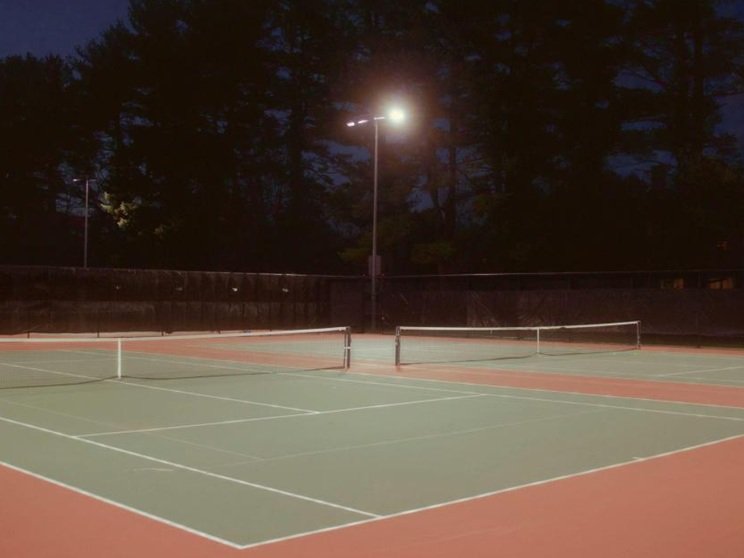
For tennis, you want to have a good sight of the ball against the background, as well as consistency in the brightness level across the entire tennis court coupled with the absence of harsh glare when looking up for a lob.
The International Tennis Federation and national bodies recommend specific levels of lux for the players, so that players can react in a safe and confident manner. On recreational courts you see around 300 lux and on higher level competition it can even go 500 lux or more.
I told a certain club that used to have players that would misjudge overheads near the corners.
We measured the light and we found big drops near the sidelines.
After a new lighting design, complaints almost overnight stopped.
Important Lighting Requirements for Tennis Courts
Standards help to keep guessing out.
You do not need to remember all the numbers, but always know the basics.
Recreational courts typically have a spell of about 200 to 300 lux with a homogeneous light distribution.
Club and training courts are often going for 300 to 500 lux.
Televised or high competition competition or go higher so cameras and spectators can get good sights.
Instructions from the USTA Sports Lighting recommendations for lighting mention the suitable horizontal illumination, uniformity ratios, and glare control for various levels applied to tennis play. Their sports lighting page also speaks to the importance of consistent lighting to allow the players to be able to track the ball and lines reliably across the entire court.
uniformity is as much as brightness.
A uniformity ratio of about 0.6 or better is common, which means that the darkest point in the point is not too far below the average.
If one baseline is bright and the other is dim in one’s mind, players can immediately tell.
Color temperature in the area of 4000K to 5000K is good but CRI of has a value in 70 to 80 and more is good for seeing the ball and lines clearly.
LED Tennis Court Lighting: Core Benefits
In converting from metal halide to LED, facilities typically are pursuing three things, less money at the bill-paying register, improved light, and a reduction in headaches.
Whereas, a typical outdoor tennis court with 8 1000 watt metal halide fixtures may consume about 8kW.
An LED lighting solution can in most cases deliver similar or superior light levels with 4 to 5kW.
That is approximately 40 to 60 percent energy savings, in some cases more, depending on the fixtures.
The U.S. Department of Energy notes that LED lighting systems can reduce energy use while maintaining or improving light output in many applications.
LED fixtures also have a longer lifespan.
Instead of changing lamps every few years, you may get 50,000 to 100,000 hours of life before noticeable change in depreciation.
That means fewer lift rentals, fewer late night maintenance calls, and less problems with bookings.
You also get the benefit of immediate on and off, there’s no warm up time and you get better control over where the light is going.
Indoor Vs Outdoor Tennis Court Lighting
Indoor tennis courts are like big light boxes.
You deal with ceiling height, wall’s colors and reflections.
If the ceiling is low, then you need to be careful in your choice of beam angle so that players will not be staring directly into the fixture with every serve.
There are challenges with outdoor tennis.
There are effects that the poles and fixtures are subject to by wind, rain, snow and temperature swings.
You also tend to have to control the light spill because your neighbor will complain if you get too bright in their windows.
I worked with a school that had indoor and outdoor tennis.
Indoors, we were concerned with even light and glare from the rafters.
Outdoors the topic changed to location of poles, shielding and local ordinances regarding light trespass.
Same sport but very different lighting requirements.
Lighting Design for Tennis Courts

Good light design begins with court dimensions and heights.
The court of a standard tennis game is approximately 23.77 meters long and 10.97 meters wide for doubles.
Pole heights often vary from 8 to 12 meters outdoors with instances at times higher for clubs where standards are more strict.
You will typically put light fixtures on either side (not directly behind the baselines).
That reduces glare when the players look to the front or upwards.
The idea is to have an even light distribution across the playing area including corners and service boxes.
Beam angle and optics matter.
Narrow beams are better from higher poles or ceilings and wider beam helps at lower mounting height.
A good lighting system includes combinations of the optics to work on brightness, uniformity, and spill control.
Outdoor LED Tennis Court Lighting Design
For one outdoor tennis court a very typical setup is to have four or six poles mounted on the sides.
There could even be two for four LED fixtures per each pole depending on output and target lux, of course.
Recreational courts may have a capacity in the area of 12 to 20kW in older style metal halide systems whereas LED can reduce this by about half.
I recall a municipal initiative to replace eight 1000 watt metal halide fixtures for eight 600 watt LED units on an outdoor municipal tennis project.
Average light levels went from around 250 lux to 350 lux and energy consumption fell around 40 per cent.
In order to keep neighbors happy we used shields and careful aim to keep the light on the court.
Commissioning mattered.
A few degrees of tilt made the difference between a dark corner or bright bedroom window.
Indoor LED Tennis Court Lighting Design
Indoors, structure is the key to numerous decisions.
You may support fixtures on trusses, beams or dedicated rails.
Ceiling height is usually 8 to 12 meters in ordinary halls, sometimes it will be higher in large centers.
You want even light on the court and no hot spots directly on top of the baseline court.
That generally increases to several rows of fixtures down the length of the hall aimed to cross illuminate the playing area.
The colors of the walls and ceiling help to define the feel.
Light surfaces also reflect more, and this can aid in uniformity but may make surfaces seem even brighter than they truly are.
Dark walls absorb light and can cause the background to be too dark for the light you are outputting from the illuminator, forcing you to either increase the output or change the way you aim.
Dust and condensation are also important.
I have seen indoor tennis courts where dirty lenses would decrease light levels by 20 percent or greater.
A good cleaning schedule did the trick, without any new equipment.
Why Use LED Lighting For Tennis Courts
Not all LED lights are suitable to use as a tennis court light.
You want good fixtures that are designed to do the job for sports lighting, as they will need good and strong housings, good optics, and reliable drivers.
Look at lumens, not just watts.
Vividons products equate to higher efficacy, like 130 to 160 lumens per watt, which means more light for less energy.
Check out CRI, color temperature, IP rating and operating temperature range.
Filters on sports grade fixtures very commonly include features such as glare shields, precise optics, and vibration resistance.
Generic floodlights may be less expensive to purchase but may cause glare, inadequate uniformity or premature failures.
Controls matter too.
If your fixtures are dimmable and smart controlled, you can run training at lower levels, and save more elements.
I usually tell facility managers to ask for product data in its entirety, they want photometric files, they want a nice warranty in writing.
LED Tennis Court Lighting Project Costs
Costs tend to vary but the structure is similar.
For new builds you pay for fixtures, poles, cabling, controls, foundations and design.
Retrofits can reuse poles and wiring that can help your budget.
As a rough idea, a single outdoor recreational court may end up in the tens of thousands, with multiple regions and standards.
Multiple court club blocks, or indoor hall climbs from there.
I hope the interesting part is payback.
If you cut energy use by 50 percent, and less maintenance is required, the project sometimes can pay for itself in three to seven years.
I worked with one club that spent more over ten years on electricity and lamp changes than was the entire cost for an upgrade of modern LEDs.
They just never saw the whole picture until we stretched out the numbers.
Installation, Commissioning and Maintenance
Good products do require good installation, however.
Start with a site survey, valid condition of pole, mounting heights and power capacity.
Plan usage of access equipment and plan work during busy times
At the time of installation, proper brackets, torque and cable management are important.
After that commissioning comes where fine tune.
You measure lux levels, uniformity, and adjust aiming in an effort to eliminate dark spots and glare.
Maintenance does not disappear with LEDs but changes.
You clean lenses, check poles and brackets, and monitor performance.
A simple annual check can prolong the life and keep your lighting system close to design levels.
Over time, you may want to consider normal disruptive replacement of drivers or fixtures, as they age, as opposed to emergency replacement.
Planning an Effective LED Tennis Court Lighting System
When you plan LED tennis court lighting, try not to start with catalog browsing.
Begin with your courts, your players, and your neighbors.
Think about target light levels, operating hours and listen for any complaints you already have.
Then ask suppliers for a complete design of lighting and not just a quote.
A proper LED tennis court lighting plan shows fixture types, optics, pole locations, and predicted lux levels.
You will be able to compare options side by side and select the lighting solution that matches your budget and long term goals.
FAQs of LED Lighting for Tennis Courts
How many lux do you want for a tennis court?
Recreational courts may aim for the range of 200 to 300 lux.
Clubs and training facilities usually go 300 to 500 lux.
High level or televised events may need to be pushed or raised so the cameras and spectators may see clearly.
How many LED lights will you need for 1 tennis court?
A typical outdoor tennis court may have eight to twelve fixtures, depending on wattage, beam angle and pole height.
Indoor layouts are more varied but you still design based on target lux and uniformity not necessarily just fixture count.
How long do LED tennis court lights last?
Quality LED fixtures will often rate for 50,000 to 100,000 hours to L70 or L80.
For many facilities, that would translate to 10 years or more before it would be noticeable for dimming, depending on hours used.
Can you conserve existing poles to LED fixtures?
Oftentimes yes, provided the poles are good structurally and at the right height.
An engineer or experienced contractor should examine loading, corrosion, and footing before you make yourself committed.
How much do you pay to get LED lighting on a tennis court?
Costs that will depend on location, standards, and if you reuse poles or not
Single courts may begin in the low tens of thousands and multi court complexes and indoor halls are more expensive.
Energy savings and less maintenance blocks of that are typically offset over time.